
The Scale of Global Rice Trade
The global rice trade moves approximately 50 to 55 million metric tonnes annually, according to USDA data. The primary exporting nations are India, Thailand, Vietnam, Pakistan, and the United States. The primary importers include the Philippines, China, Nigeria, Saudi Arabia, and the UAE.
India is the dominant player — accounting for over 40 per cent of global rice exports in recent years, with particular strength in Basmati and non-Basmati long grain varieties. Thai jasmine rice and Vietnamese long grain hold strong positions in Southeast Asian and African markets. Pakistani Basmati competes directly with Indian Basmati across the Gulf and European markets.
The volume, variety, and geographic spread of this trade reflect a simple truth: rice does not grow everywhere it is needed, and it does not grow in uniform quality everywhere it does grow. Trade exists to bridge that gap.
Why Countries Import Rice
Food security. For countries that cannot produce enough rice domestically to meet demand — whether due to climate, land availability, or population density — imports are not optional. They are essential. The UAE imports between 80 and 90 per cent of its food commodities annually, including virtually all of its rice. Without a functioning global trade infrastructure, food security in the Gulf would be structurally impossible.
Quality and variety of access. Domestic production, even where it exists, rarely covers the full spectrum of rice varieties a diverse population demands. The UAE's population — over 80 per cent expatriate, drawn from South Asia, Southeast Asia, and the Arab world — consumes a range of rice varieties that no single origin can supply. Basmati from the Himalayan belt, Sona Masoori from the Deccan, Ponni and Matta from Kerala, Kalijeera from Bengal, jasmine from Thailand. The only way these varieties reach the UAE shelf is through international trade.
Price stability. A diversified import base — multiple origins, multiple suppliers — provides a buffer against supply shocks. When a drought reduces output in one producing region, a buyer with relationships across multiple origins can maintain supply continuity. A buyer dependent on a single origin is exposed.
Why Countries Export Rice
Foreign exchange earnings. Rice is a significant source of foreign exchange for major exporting nations. India's rice export revenues regularly exceed USD 9 to 10 billion annually. For smaller exporting nations, rice is often among the top three agricultural export earners. The foreign exchange generated by rice exports funds imports in other categories — equipment, energy, technology — that domestic production cannot supply.
Agricultural sector development. Export demand creates the commercial incentive for investment in agricultural infrastructure — better irrigation, improved seed varieties, more efficient milling and processing technology. Countries with strong export markets for rice tend to have more productive domestic rice sectors as a direct result.
Trade relationships and diplomatic leverage. Food trade creates durable bilateral relationships. A country that reliably supplies another country's staple food commodity is a country whose diplomatic and commercial interests are taken seriously. India's rice export relationships across the Gulf are not merely commercial — they are part of a broader pattern of strategic engagement.
The Role of Private Trade in the Rice Supply Chain
Governments set the framework. Private traders move the product.
Between the farm in Punjab or the Godavari delta and the supermarket shelf in Dubai, the rice passes through a supply chain that involves primary producers, millers, exporters, freight forwarders, customs brokers, commodity traders, importers, distributors, and retailers. Each stage adds value — grading, certification, logistics, credit, risk management — and each stage depends on the competence and reliability of the partners involved.
The quality of that supply chain — its reliability, its compliance with regulatory requirements, its ability to deliver on specification and on time — is what separates a functional food trade relationship from a recurring operational problem.
For buyers in the UAE, the choice of trading partner is not a secondary decision. It is the decision that determines whether the product arrives as described, whether the documentation clears customs without delays, and whether the shelf stays stocked when demand spikes during Ramadan or the Eid period.
What Good Rice Trade Looks Like
The best commodity trading relationships share several characteristics.
Origin transparency. The buyer knows where the rice was grown, who processed it, and what standards were applied at each stage. Traceability is not just a regulatory requirement — it is the basis for quality accountability.
Grade consistency. The rice that arrives in the fifteenth shipment performs the same as the rice that arrived in the first shipment. Grade drift — incremental deterioration in quality that falls within the tolerance of the contract but cumulatively degrades the product — is a common failure mode in commodity supply relationships. Buyers who test every batch protect themselves from it.
Documentation discipline. COA, Halal certification, country of origin, phytosanitary certificates where required — all prepared before dispatch, all accurate, all ready to present to customs or a hypermarket procurement team without delay. Sloppy documentation is one of the most common and most avoidable causes of supply chain disruption in the UAE food trade.
Responsive account management. When something goes wrong — a delay, a specification query, a documentation issue — the response time and competence of the account manager on the other end of the phone determines how quickly and how well the problem is resolved.
The UAE as a Rice Trading Hub
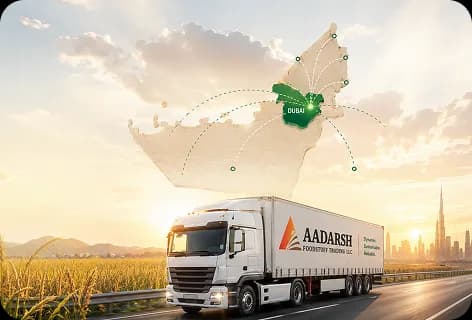
The UAE occupies a unique position in the global rice trade. It is simultaneously a significant importer — feeding a large and diverse resident population — and a re-export hub, with Jebel Ali Port providing the logistics infrastructure to move product onward to other GCC markets, East Africa, and beyond.
This dual role means the UAE rice market rewards suppliers who understand both the retail demand side and the logistics and compliance requirements of re-export trade. A product successfully introduced into the UAE market has a natural pathway to broader GCC distribution — provided the supplier has the documentation, the compliance framework, and the market relationships to support it.
For food producers in India, Pakistan, and Southeast Asia, the UAE is not just a market. It is the most efficient entry point into a regional trade network that covers a combined population of over 50 million people.
Why This Matters for Your Business
Whether you are a rice producer looking to enter the GCC market, a distributor looking for a more reliable supply partner, or a HORECA operator trying to maintain consistent quality across a busy kitchen, the mechanics of rice trade are directly relevant to the decisions you make every day.
The short version:
A well-managed rice supply chain — from origin selection and quality control through documentation, logistics, and distribution — is what separates a commodity from a competitive advantage. The businesses that invest in getting the supply chain right do not just reduce their risk. They build the foundation for consistent quality, customer loyalty, and sustainable margin.
That is what Aadarsh has been building since 2018. One shipment at a time.
Interested in trading rice with Aadarsh? Whether you want to buy or sell — the conversation starts here.
Submit a trade enquiry → WhatsApp: +971 52 679 0685 Response Within 24 hours, Mon–Fri, 9 am–6 pm GST.